U.S. compliance execs see little impact yet of Trump deregulation on decisions, budgets – survey

This article was republished with permission by the copyright holder, Thomson Reuters. It first appeared in the Thomson Reuters Regulatory Intelligence subscription service for compliance and risk professionals.

Written by Richard Satran for Thomson Reuters Regulatory Intelligence – first published on April 19, 2017.

A wave of financial services deregulation promised by the administration of U.S. President Donald Trump has so far had little impact on decision making by top risk and compliance officers, a survey at a major industry conference last month found.

Political issues are “not yet weighing heavily on compliance decisions” for 85.2 percent of those polled by financial services communications firm IPC in its survey taken in March, entitled “The C-Suite and Compliance.” However, 9.8 percent viewed the potential regulatory changes as important enough to postpone key decisions for later in the year. Only 4.8 percent saw them significantly affecting decisions already made.

The response came from top level risk and compliance executives, with 81 percent holding C-level positions as chief compliance officers or chief legal counsels as well as chief risk, data, information and operations officers, and chief executive officers. The survey was compiled at the 2017 Securities Industry and Financial Markets Association Compliance and Legal Society Annual Conference on March 19-20, in San Diego.

The Trump administration took office in January with a flurry of activity aimed at peeling back the Dodd-Frank legislation of the prior administration. But delays and legal obstacles have so far stalled most of the initiatives.

Nearly seven years after the passage of Dodd-Frank, which resulted in an unprecedented roll out of regulations for financial firms, compliance executives say they are “supporting business goals” and continuing to implement regulatory requirements.

“Global financial services firms’ regional politics tend not to play as a large a role as one might expect,” explained Michael Speranza, IPC senior vice president, corporate strategy. What’s more, he said, “generally, the region having the most stringent regulatory requirements will guide how you do business globally.”

Speranza said that U.S. firms that fail to keep up with global requirements under the European Union’s MiFID II record-keeping obligations would ‘place a U.S. firm at a disadvantage ” if regulatory questions arise. “Trying to defend yourself without this data can be a tricky proposition,” he said. “Non-compliance can lead to millions of dollars in fines or reputational damage for companies not wise enough to take it seriously.”

The potential demands of regulators outside the United States are keeping firms wary of easing compliance, he said. It explains why compliance culture and conduct concerns remain the top issue for the group made up largely of chief compliance, risk, data, information and legal officers, with 89.3 percent calling a top concern. Understanding rules and regulations remained a high priority (87.3 percent), along with implementing new regulations (86.4 percent).

Nearly all of the firms increased investment in risk and compliance programs over the past year. Most of the firms (80 pecent) said spending had gone up 20 percent, another 5.9 percent spent 10 percent-to-20-percent more. Just 6.0 percent stayed at the same level.

MiFID II: Meeting voice and archiving requirements

By Robert Powell, Global Director of Compliance at IPC for bobsguide – first published March 29, 2017

With MiFID II implementation high on financial firms’ agenda, there is going to be a major change in the way that trading communications are recorded and stored. Both mobile and electronic trading communications have increased significantly over the last few years, which is reflected in the new rules that extend the scope of communication recording and surveillance to include all types of interactions, including text, IM, email, mobile, and social media. This is an ever-growing challenge for financial firms who must capture data from all their regulated users involved in pre-, during and post-trade activities and include communications from far beyond the trader’s turret.

Under MiFID II, records will also need to be retained for a period of five years, which will push firms to review and update their retention strategies. In the United States, the Commodities Futures Trading Commission’s (CFTC) rules require voice calls to be retained for one year while text communications are retained for five years.

One of the biggest change for businesses is that these new interactions are creating significantly greater volumes of data from disparate sources that must be retained and managed for potential regulatory requests and review. Unsurprisingly, most firms want to manage this data holistically as opposed to using a resource-intensive and siloed approach to each type of data source. It’s becoming increasingly important for firms to rely on a platform that stores and catalogues both e-communications and voice communications – seamless capture, archive and analytics through a convenient and cost-effective cloud-based system instead of one requiring more onsite infrastructure and people to manage.

Record retention and voice recording

With regards to voice recording, MiFID II stipulates that firms must conduct surveillance of key communications to ensure that they are compliant with market rules. In order for this to be effective, clever technology will need to be deployed; technology that can identify the context and impact of what is being spoken about, and can deliver insight into risks to ensure no wrongdoing is occurring.

Most financial markets records retention regulations also demand electronic communications and voice recordings be preserved, as far as possible, in their original form. This can be challenging when managing voice recordings should the quality of audio recordings not be good enough. Furthermore, voice recordings take up a lot of space so firms will need to ensure that they have adequate storage to hold this data. The good news is that the market is responding and newer communication devices are offering pristine audio for compliant call capture, retrieval and analytics to meet regulator requests.

Another challenge firms are facing is that many have legacy platforms that were built to meet the initial demand for WORM (write-once, read-many) storage at the advent of Dodd-Frank’s records-retention requirements. However, these systems are aging, and many are, or soon will be, end-of-support or end-of-life. Businesses are subsequently facing a costly hardware refresh and many are looking to outsource their archival.

Reducing risk holistically

As the European regulatory environment becomes more complex – and upcoming regulations such as General Data Protection Regulations (GDPR) will only add to the complexity – there is a growing need for a unified archiving platform for customers providing a single pane of glass into all of their communications. Increased regulatory requirements have also added several important reasons to automate the archiving process which should be heeded for customers to remain competitive. Firstly, customers must attest that records have not been altered at any point in the archiving process, and they must remain tamper-proof for the duration of their retention. Secondly, customers must have tighter control over enforcing their retention policies across all forms of communications, and further ensuring that they are not over-retaining data – something GDPR refers to – by having a defensible set of policies and procedures for deletion. Finally, when needed, customers must be able to quickly reproduce all communications leading up to a specific transaction or in a given time period.

The increasing breadth and complexity of record-keeping and record-delivery guidelines is pushing firms to find a way of holistically managing all communication data from the point of origination through capture, archive and transaction analysis. Indeed, this will be a competitive advantage for financial services firms that want to ensure that they comply with regulatory requirements, such as MiFID II, as efficiently as possible and improve their risk management capabilities.

With less than a year to go until MiFID II is enforced, firms need to be taking steps – if they aren’t already – to put tools and processes in place that will meet the new regulations around voice recordings and archiving. They should be focusing on finding means of capturing calls more efficiently and effectively, and implementing a unified archive that will guarantee the safe keeping and easy access of their data for the following five years. It’s crucial that businesses remain compliant without the risk of any misunderstandings – the repercussions of failing to do this are just too high.

IPC Survey Reveals C-Suite View on Compliance Investments, Financial Firm Challenges

NEW YORK, April 20, 2017 – Compliance culture and conduct, understanding new regulations and rules, and “operationalizing” responses to new regulations are the top three compliance issues for C-level executives at financial markets companies, according to a new IPC Compliance survey of 2017 Securities Industry and Financial Markets Association (SIFMA) Compliance and Legal Society Annual Conference attendees. IPC is a leading global provider of risk and compliance communications solutions for the financial markets community.

When asked how much political risk and perceived instability were affecting their decision-making on how to manage risk and compliance, 85 percent of financial firm executives surveyed indicated there was no impact nor did they see a difference in their business.  In terms of technology-related compliance issues, three key areas far outpaced others:  93 percent of the participants cited data management; 91 percent cited network resilience/uptime and 89 percent noted the integration of communications records and archival.  Investments in risk and compliance have grown significantly in the past year, with nearly 90 percent of those surveyed reporting at least a 10 percent increase in compliance-related spending while more than 80 percent cite a 20 percent or more increase in compliance-related spending.  Some 82 percent of financial executives respondents use risk and compliance strategy and investment as a competitive advantage, according to survey results.

“As we at IPC well know, compliance is not being taken lightly by the world’s financial firms as MiFID II rules rapidly approach and regulatory pressure continues to mount,” said Lionel Grosclaude, Senior Vice President, Risk and Compliance and Managing Director for EMEA. “Concerns over capturing, archiving and retrieving data for all regulated users and from many disparate communications sources have grown exponentially as has the need to utilize the data to drive meanful insights.  That’s why addressing the complete spectrum of financial markets’ company information governance challenges with expertise, counsel and technology solutions is essential for businesses to advance.” 

The IPC Compliance Survey was conducted in-person at the 2017 Securities Industry and Financial Markets Association (SIFMA) Compliance and Legal Society Annual Conference on March 19 and 20, in San Diego, CA. In total, 103 conference attendees were interviewed. For more information, please download the IPC Compliance Survey e-book and infographic.

About IPC

IPC is a technology and service leader that powers financial markets globally. We help clients anticipate change and solve problems, setting the standard with industry expertise, exceptional service and comprehensive technology. With customers first and always, we collaborate with each to understand their individual needs to help make them secure, productive and compliant within our connected community. Through service excellence, long-developed expertise and a focus on innovation and community, we provide agile and efficient ways for our customers to accelerate their ability to adapt to the ever–changing requirements for advanced data networks, compliance and collaboration with all counter-parties across the financial markets. www.ipc.com

Certain statements contained in this press release may be forward-looking statements. These statements may be identified by the use of forward-looking terminology such as “anticipate,” “believe,” “continue,” “could,” “estimate,” “expect,” “intend,” “may,” “might,” “plan,” “potential,” “predict,” “should” or “will” or similar terminology. Any forward-looking statements are based on current expectations, assumptions, estimates and projections. Such forward looking statements involve known and unknown risks and uncertainties, many of which are beyond our control. Actual results may differ materially from any future results expressed or implied by these forward-looking statements.

#  #  #

Friend or foe? Some banks see growing fintech industry as an asset, while others see it as unwanted competition

By Brett Johnson for NJBiz – first published April 3, 2017. Photo by Aaron Houston.

Officials at IPC Systems Inc. see the company as being part of the evolution of industries such as banking, not at odds with it.

The Jersey City-based fintech company provides various communications services to the financial trading community — a collective of international banks, management and asset management firms, hedge funds and trade venues.

It’s a thriving market with a lot of attention from investors.

Michael Speranza, the company’s senior vice president of corporate strategy, mergers and acquisitions, and marketing, said the fintech industry has been accruing investment at a faster rate than almost any other industry.

Speranza couldn’t be more excited.

And his real hope is that the excitement about the fintech boom that he sees among traditional financial institutions is as strong as he thinks it is.

“A lot of these (institutions) don’t look at fintech as adversarial, they look at it and say — it’s coming, and my participation in it or not is going to be significant for my business downstream,” he said. “More so than ever, we’re seeing them willing to invest in these solutions, too, and seeing that it can benefit their business.”

On the other hand, David Frankil of the New Jersey Credit Union League isn’t as excited.

In fact, among the financial services firms, banks and credit unions he advocates for, fintech isn’t universally thought of as an ally, given that, for every complementary product that comes through the fintech pipeline, there’s an industry competitor in lockstep.

“It sort of depends on your perspective as to whether you see fintech as a threat or an opportunity or both,” Frankil said.

What-tech?

At the outset of any conversation about fintech is the question: What are we talking about?

Not shy to buzzwords, the tech industry in its convergence with the financial sector inspired a term that encompasses everything from digital mortgage lending company Quicken Loans to that impossible-to-understand blockchain payment network known as Bitcoin.

Don Musso of Gladstone-based FinPro said there’s a tendency to throw everything into the area of fintech. But, he said, fintech generally is defined by the application of technologies to the broad financial services sector.

Still, it’s difficult to capture all that fintech can mean, said David Frankil, CEO of the New Jersey Credit Union League.

“What some refer to as emerging fintech companies probably would not have been put in category of financial services companies at all, except that they have big implications on those companies,” Frankil said. “You’re not going to see any of that in Merriam-Webster.”


John McWeeney, the CEO and president of the New Jersey Bankers Association, sees fintech companies as both an ally and an adversary.

McWeeney pointed to Mirador, an Oregon fintech outfit that creates automated online small business lending platforms for community banks, as a success story.

NJBankers was one of the industry associations Mirador contacted to spread the word about its services. The organization now refers small banks that don’t have the capabilities to build a digital lending platform alone to Mirador.

On the other hand, McWeeney keeps a wary eye on the rise of another fintech company, Kabbage Inc., a growing Georgia-based firm that bypasses banks altogether and provides funding directly to small businesses.

McWeeney said the impact of competitive fintech firms isn’t dealing a significant blow to the industry, at least not yet.

“But I think, over time, banks need to be more aware of this and have a strategic plan on how they’ll respond,” he said. “Especially with millennials, they’re drawn to doing things this way — solely through technology. So, it’s a whole generation of customers that risks being handed over to these providers.”

It’s the same attitude that financial institutions take to just about any technology, given that it’s not just fintech that’s disrupting the industry.

Frankil spoke to the impact of popular ride-sharing apps, such as Uber and Lyft, on lending.

Loans for taxi medallions, those small metal shields fastened to the hoods of taxi cabs, which credit unions have historically been strong providers of, are becoming bad deals, Frankil said.

“All of a sudden, those taxi medallion loans aren’t worth today what they were yesterday,” he said. “So, you’ve got these credit unions that hold the loans having to write them down because folks that own them either can’t make payments or are having difficulty doing so.”

A generation of renters

In its entrance into the New Jersey market, Unison Home Ownership Investors is hoping to address the challenges facing millennials who want to buy their first home.

Across the nation, this demographic has trailed previous generations in homeownership, according to Jim Riccitelli, a co-CEO of Unison.

“So they’re renting, even if those rents rates are astronomical,” Riccitelli said. “And the more rent you pay, the harder it is to come up with that down payment. So, you end up chasing your tail in a way. It’s a big problem.”

According to a survey from another fintech firm, LendingTree, Pittsburgh has the most millennials looking to buy a home in the company’s marketplace, with 48.4 percent of all mortgage requests coming from millennials.

Washington, D.C., was a close second by that measure, at 46.8 percent. No Garden State city found a place in its rankings.


Like any new tech-based business model, there is some question of how fintech ultimately will sit with regulators.

“Regulatory regimes have usually wagged new technology developments, that’s true for almost any industry,” Frankil said. “Maybe it takes a scandal or two to bring that attention to fintech, a headline-grabbing issue that drives demand for regulation.”

Just as financial institutions have mixed feelings about what the fintech boom will bring, Don Musso, CEO and president of bank consulting firm FinPro Inc., said there’s no agreement on how fintech firms should be supervised or regulated.

Or if they should be at all.

“Most banks aren’t demanding it,” Musso said. “It’s a 50/50 battle over whether they should have that scrutiny or not. But if it ever becomes a big enough threat to banks’ survival, you can bet there will be demands for oversight.”

Musso added that it’s a conversation that already is happening.

In December, the Office of the Comptroller of the Currency issued a paper announcing a proposal to create a special purpose national bank charter available to fintech companies.

While not all fintech firms offer bank-like services, some do have non-deposit products that have attracted attention.
Venmo, for example, is a fintech firm that has taken the peer-to-peer transaction market by storm, and is set to quickly overtake any bank service of this sort in terms of volume.

“There’s no magic to it,” Musso said. “It exchanges money from one FDIC-insured account to another. But it does it quickly, easily and it’s user friendly. There’s no doubt tech like this is going to change the delivery method of banks.”


Fintech firms also are slowly entering the residential mortgage space.

This is an area of business some banks are nervous about new players encroaching in. But, again, it’s not universally the case that fintech firms are courting bank customers in this area.

Unison Home Ownership Investors, for instance, would argue it’s the best thing for banks. Unison said its products — which can provide half of the down payment for a mortgage in exchange for a chunk of the potential increase in value on the home — only up the potential pool of home buyers.

Jim Riccitelli, one of the company’s co-CEOs, said this could be good for everyone.

“This is highly complementary to the lender,” Riccitelli said. “They’re dealing with challenges on a daily basis in helping their clients get qualified for a mortgage loan. We can come into the picture and enable more clients to qualify.”

Riccitelli said that’s important in a time of tightened mortgage-lending standards and soaring home prices. The California-based company offers its service in New Jersey, among a handful of other states. Riccitelli said Unison selected the Garden State as one of its markets due, in part, to the region’s high home prices.

Thomas Sponholtz, the company’s chairman and its other co-CEO, said their firm’s service allows people more flexibility in getting the home they want. It’s something that didn’t exist in this form before Unison, he said.

“This is true innovation, whereas most of what’s called that is focused on a different way to distribute the mortgage and make it easier to get a loan — a lot of fintech is focusing on that,” Sponholtz said. “And those firms are stealing market share from banks. It’s not what we’re doing … but there’s nothing wrong with (it).”

Prime among those competitive forces is the mortgage lender Quicken Loans and its Rocket Mortgage program.

With a segment of fintech firms looking to take market share away from financial institutions, some industry experts are taking a pragmatic view.

“(These companies) are making inroads; there’s no doubt there’s competition there,” Musso said. “The best thing about it is that it’s forcing banks to re-evaluate all of the processes to get products to customers quicker, faster and cheaper. It’s a good, competitive kick in the butt.”


Adopting a zero-tolerance compliance culture

By Robert Powell, Global Director of Compliance at IPC for Fund Technology – first published April 2017

With the Markets in Financial Instruments Directive (Mifid II) deadline extended to January 3, 2018, European firms are now at various stages of readiness, with most on schedule to be compliant with the new rules when, or soon after, they go into effect.

Although Mifid II is an ostensibly EU-based directive, financial firms in other regions that trade with European counterparties are held accountable by European regulators to remain compliant with some of the new rules.  An example of this is in the communications retention space where, despite Mifid II bringing greater parity in retention periods, U.S. firms may lack compliance in several areas.

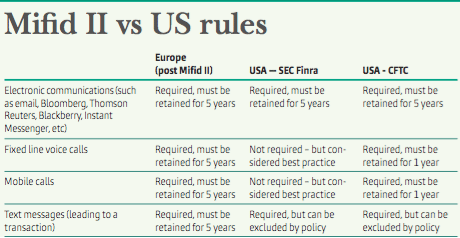
The Commodity Futures Trading Commission, like Mifid II, requires telephone calls – land line and mobile – to be captured and retained for five years in Europe and one year in the U.S.  Retention periods, media types and the use of policy to prevent certain behaviour are all treated differently by European regulators than by their U.S. counterparts.

The table below outlines some of the differences in requirements between the new Mifid II rules and the current U.S. equivalent rules.

For a long time in the U.S. policy has been employed in conjunction with attestation, which is not widely used in Europe where policies are typically required to be tested as being effective. In the telecommunications space, it is particularly hard to test rules where “bring your own device” policies are in place without running into privacy issues if you ask an employee to divulge details of personal calls placed on personal devices an employer has no right to inspect. But MiFID II dictates that firms must take reasonable steps to prevent the use of personal devices that cannot be recorded. The regulatory pull and the privacy rights of an employee will make this almost impossible to enforce through policy.

Firms that deal with European counterparties or clients will be expected by regulators to be compliant with the new rules to participate in the market.  That will include how you handle research and record retention.

What is the risk for U.S. firms that aren’t preparing for Mifid II?  A U.S. firm could be asked by a European regulator to produce records and be required to explain its actions in the European marketplace but because without consistently recorded communications, they will be unable to produce defence records.  With the new rules, the European regulators may have more data than the firms they are questioning, as the call will almost certainly have been recorded by the European firm as part of their MiFID II record-keeping obligations. This may place a U.S. firm at a disadvantage.  Trying to defend yourself without this data may prove difficult.

One of the easier ways to mitigate risk in this new era of greater global regulation is to adopt a zero-tolerance compliance culture.  That means any employee who violates company policy is subject to termination. It begins with training that is constant, audited and evolves as the organization matures in its compliance culture. Before adopting this kind of environment it is important to clearly communicate your firm’s rules and requirements. Working closely with compliance, legal and human resources, a firm should conduct a thorough audit of internal policies to ensure they are aligned with a zero tolerance Innovation and adoption of new technology should be continually verified to be in line with the organization’s rules.  Technology can provide greater efficiency and understanding for improving processes while also used for zero-evidence application.

Non-compliance can mean millions of dollars in fines for companies not wise enough to take it seriously.

IPC’s Financial Markets Network Wins ‘Best Sell-Side Trading Network’ Category in Waters Technology’s 5th Annual Sell-Side Technology Awards

NEW YORK, April 6, 2017 — IPC Systems, Inc., a leading global provider of secure, compliant communications and networking solutions for the financial markets community, announced today that the IPC Financial Markets Network has been selected as the “Best Sell-Side Trading Network” in Waters Technology’s 5th annual Sell-Side Technology Awards program for the second time in just five years. The Sell-Side Technology Awards recognize the leading technologies and third-party vendors in their area of expertise.

The IPC Financial Markets Network (FMN) is a robust Ecosystem-as-a-Service solution that integrates a dynamic community of sell-side firms, buy-side firms, inter-dealer brokers, liquidity venues, energy firms, trade lifecycle services, market data providers and clearing/settlement firms. The sell-side leverages the FMN to connect to the buy-side community to provide trade lifecycle services and enable the execution of a range of trading strategies.  This allows capital market participants to better focus on their core business of alpha generation and best execution rather than on network technology.

“We’re honored to be selected once again as the Best Sell-Side Trading Network by Waters Technology,” said David Brown, Senior Vice President and Managing Director, Financial Markets Network, IPC.  “IPC continues to strengthen, connect and transform the financial markets by continually advancing our Financial Markets Network through the cloud as well as integrated services for biometric, encryption and blockchain technologies, to name a few.  In this, and many other ways, we enable our diverse base of global market participants to gain a competitive advantage.”

“This award is a testament to the relentless innovation and expansive financial markets community that IPC Systems has built, uniting and empowering an industry,” said Victor Anderson, editor-in-chief of Waters Technology. “The IPC Financial Market Network is a robust, multitiered platform that won over the judges in one of the more competitive categories and we’re pleased to present this Sell-Side award to them.”

The IPC Financial Markets Network portfolio includes Connexus Extranet, Connexus Ethernet, Connexus WAN, Connexus Voice and Trader Voice services. IPC’s Financial Markets Network interconnects global financial centers and allows access to more than 6,000 market participant locations across 700 cities in more than 60 countries.

It includes:

  • FX Hub – a low latency, co-located performance solution engineered to address the most complex FX trading challenges
  • Fixed Income Marketplace – a premier holistic connectivity solution for market participants to trade fixed income instruments electronically or via voice
  • Global Exchange Reach – provides exchanges a local presence in a remote region to expand their reach
  • Connexus Infrastructure Services – a managed private and hybrid Infrastructure-as-a-Service (IaaS) with global availability at premier co-location facilities
  • Connexus Chrono – a turnkey clock synchronization and time stamping service engineered to deliver high precision, synchronized and traceable time feeds to global financial market participants.

IPC’s FMN provides thousands of sub-ecosystems throughout the trade lifecycle and across multiple asset classes – equities, fixed income, currencies, commodities, and their derivatives – futures, options, forwards and swaps.  It encompasses more than 2,000 sell-side firms including leading investment banks, brokers, dealers, inter-dealer brokers and prime brokers. Additionally, many of the dealer banks in the FMN ecosystem have asset management divisions that cater to institutional and wealthy individual clients. Sell-side firms in the FMN community also operate internal hedge funds and take on private equity partnerships as part of their business services.

About Sell-Side Technology

Sell-Side Technology covers how financial institutions maintain their competitive advantage by making strategic investments into their front-office trading systems; examines internally developed and third-party systems being brought to market and the latest technology’s impact on the industry. Sell- Side Technology is published by Incisive Media Plc. For more information, please visit www.watersonline.com and www.incisivemedia.com.

About IPC

IPC is a technology and service leader that powers financial markets globally. We help clients anticipate change and solve problems, setting the standard with industry expertise, exceptional service and comprehensive technology. With customers first and always, we collaborate with each to understand their individual needs to help make them secure, productive and compliant within our connected community. Through service excellence, long-developed expertise and a focus on innovation and community, we provide agile and efficient ways for our customers to accelerate their ability to adapt to the ever–changing requirements for advanced networks, compliance and collaboration with all counterparties across the financial markets. www.ipc.com

Certain statements contained in this press release may be forward-looking statements. These statements may be identified by the use of forward-looking terminology such as “anticipate,” “believe,” “continue,” “could,” “estimate,” “expect,” “intend,” “may,” “might,” “plan,” “potential,” “predict,” “should” or “will” or similar terminology. Any forward-looking statements are based on current expectations, assumptions, estimates and projections. Such forward looking statements involve known and unknown risks and uncertainties, many of which are beyond our control. Actual results may differ materially from any future results expressed or implied by these forward-looking statements.


#  #  #

Effectively addressing the Communications and Connectivity Challenges of Financial Market participants

By Tim Carmody VP, Network Product and Engineering at IPC for e-Forex Magazine – first published March 2017

Connectivity is critical for capital market participants – but that’s nothing new. The financial markets industry has been talking about the importance of connectivity for data and voice communications for quite some time. What is new is that financial firms worldwide are increasingly being encouraged to address their communications not only to meet upcoming regulations, such as MiFID II, but also to adopt new paradigms, and get closer to clients, so that they can source liquidity more easily.

COMMUNICATION CHALLENGES

Given today’s volatile markets, investment managers and brokers are continually faced with a number of complex trading challenges. Indeed, financial organisations are under growing pressure to support collaboration across the enterprise, seamlessly share corporate resources and applications, enable best trade execution and securely connect all of their multiple locations around the globe. Conquering these challenges is essential for firms needing to remain competitive, however, cost, a lack of resources and performance issues can often stand in the way.

To connect multiple office locations and distributed services firms must ensure they have a private and secure infrastructure that enables mission-critical enterprise connectivity for data, voice and video applications. More and more institutions are migrating their on-premise solutions to cloud-based models. Scalable and adaptable, the cloud has the advantage of being able to power new workfl ows, meet stricter regulatory and security requirements, and provide the fl exibility needed to integrate new innovations and applications when necessary. To do so, cloud-based services and distributed trading execution, embedded at liquidity centers, require coherent, secure connectivity.

CLOCK SYNCHRONISATION AND TIME-KEEPING

Ensuring accurate and secure clock synchronisation and time-stamping is also a major challenge for financial firms. Indeed, with the regulatory environment becoming increasingly stringent, the need for pre- and post-trade transparency is growing with each passing year. Any firm that trades in the United States or European Union needs reliable, synchronised clock feeds to connect to their trading applications and order management systems.

Time precision and stamping are at the heart of regulatory compliance with MiFID II RTS-25 and FINRA Rule 4590, placing strict requirements on the granularity of timestamps and the maximum divergences of clocks that are being read. Clock synchronisation subsequently plays a critical role in investor protection by being a mechanism that further supports fair, safe, efficient, and transparent markets.

In addition to electronic trading compliance, firms relying on voice trading also need to remain compliant by guaranteeing their voice systems record legacy T1s and E1s through reliable clocking to avoid a degraded service and enable regulatory monitoring of trading activity.

DRIVING BUSINESS GROWTH

All financial firms have their complexities; however, their networks shouldn’t be one of them. It is important that firms ensure they are able to embed services closer to liquidity venues and market participants, whether co-located or across a wider community. Another industry trend is SaaS and Cloud-based models fast becoming the norm within the financial markets community. As such, market participants need high precision, synchronised and traceable time feeds across different technologies and across global markets.

IPC is an expert in helping the financial community interact and proactively address market challenges, ensuring firms remain connected and compliant. The company offers one of the largest Financial Markets Network portfolio, connecting global financial centres and allowing access to more than 6,000 market participant locations across 700 cities in more than 60 countries. The portfolio includes data connectivity solutions consisting of the Connexus Extranet, Connexus Ethernet and Connexus WAN, as well as voice solutions consisting of Connexus Voice and Trader Voice services.

The company’s Connexus Infrastructure Services (CIS), a managed private and hybrid Infrastructure as a Service (IaaS), enables financial firms to execute a variety of electronic trading strategies and embed services closer to liquidity venues and market participants, whether co-located or across a wide community.

IPC also recently launched Connexus Chrono, a turnkey clock synchronisation and time stamping service engineered to deliver high precision, synchronised and traceable time feeds to global financial market participants. The service can be delivered in a variety of different levels of accuracy ranging from 1 microsecond to 250 microseconds, and is delivered worldwide.

IPC and TransFICC Announce Collaboration on Fixed Income and Derivatives Connectivity

NEW YORK and LONDON – April 4, 2017 – IPC, a leading global provider of secure, compliant communications and networking solutions for the financial markets community, today announced its collaboration with TransFICC, the financial technology company which provides “One API for eTrading” for the fixed income and derivatives markets.  The collaboration will provide over 6000 market participants in IPC’s diverse Fixed Income Marketplace with secure access to the production and UAT environments of TransFICC’s high performance API. The IPC Fixed Income Marketplace is a premier holistic connectivity solution for market participants to trade fixed income instruments electronically or via voice.

TransFICC’s consolidated API enables buy-side and sell-side clients to connect with multiple electronic trading venues. The API is designed for fast market data throughput, and to ease the process for clients connecting to new liquidity venues and upgrading when venues update their APIs.

“Electronification, regulatory impact on bank balance sheets, liquidity shifts to the buy-side, and fragmentation of trading venues and protocols continue to affect the global fixed income and derivatives markets,” said Tim Carmody, Vice President, Global Product Management and Engineering, Financial Markets Network, IPC, “As a result, secure and reliable connectivity is crucial to sourcing liquidity, linking market participants and enabling all-to-all trading for fixed income market participants.”

Carmody continued “We are excited to work with TransFICC to enable market participants in the IPC Fixed Income Marketplace to connect to their counterparties and source liquidity.  This includes access to our vast community as well as secure, reliable connections to other private and public clouds such as the Equinix Cloud Exchange and Amazon Web Services.”

“TransFICC offers flexible and scalable technology required to address the issues of fragmentation, high throughput market data and MiFID II reporting in the fixed income market,” said Steve Toland, Founder of TransFICC. “By collaborating with IPC we offer clients access to the TransFICC platform through IPC’s secure Fixed Income Marketplace, easing the process of connecting to new liquidity venues.”

Fixed Income Marketplace is part of the IPC Financial Markets Network portfolio which also includes Connexus Extranet, Connexus Ethernet, Connexus WAN, Connexus Voice and Trader Voice services. IPC’s Financial Markets Network interconnects global financial centers and allows access to more than 6,000 market participant locations across 700 cities in more than 60 countries.

About TransFICC

Launched in 2016, TransFICC provides technology, which addresses the three issues of fragmentation, market data throughput and MiFID II/R regulation. Its “One API for eTrading” delivers low latency, scalable and secure connectivity for banks and the buy-side trading in the fixed income and derivatives markets. The TransFICC development team has significant technical expertise, having previously worked for LMAX Exchange, recognized for its technological excellence and innovation.
www.transficc.trade

About IPC

IPC is a technology and service leader that powers financial markets globally. We help clients anticipate change and solve problems, setting the standard with industry expertise, exceptional service and comprehensive technology. With customers first and always, we collaborate with each to understand their individual needs to help make them secure, productive and compliant within our connected community. Through service excellence, long-developed expertise and a focus on innovation and community, we provide agile and efficient ways for our customers to accelerate their ability to adapt to the ever–changing requirements for advanced networks, compliance and collaboration with all counterparties across the financial markets. www.ipc.com

Certain statements contained in this press release may be forward-looking statements. These statements may be identified by the use of forward-looking terminology such as “anticipate,” “believe,” “continue,” “could,” “estimate,” “expect,” “intend,” “may,” “might,” “plan,” “potential,” “predict,” “should” or “will” or similar terminology. Any forward-looking statements are based on current expectations, assumptions, estimates and projections. Such forward looking statements involve known and unknown risks and uncertainties, many of which are beyond our control. Actual results may differ materially from any future results expressed or implied by these forward-looking statements.


#  #  #

IPC Launches Global Exchange Reach Solution

BUDAPEST – March 29, 2017 – IPC, a leading global provider of secure, compliant communications and networking solutions for the financial markets community, today announced the launch of Global Exchange Reach, a premier, industry-leading connectivity solution that enables exchanges, alternative trading systems (ATSs), multilateral trading facilities (MTFs) and other liquidity venues located in one part of the world to attract order flow and distribute market data in new geographies. The solution is already in production for Singapore Exchange (SGX) in North America where IPC manages the SGX Chicago Hub at CME Group’s facility in Aurora, Illinois. The announcement is part of IPC’s rapid expansion of its product portfolio and was made here at the World Exchange Congress.

“Liquidity venues are increasingly looking to attract institutional investors, asset managers, hedge funds and market makers outside their primary market to fuel profitable and sustainable growth,” said Anthony J. Perrotta Jr., Chief Executive Officer, TABB Group, an international research and consulting firm focused exclusively on the capital markets. “At the same time, the investment community is seeking new ways to create alpha, source liquidity, diversify portfolios, manage trading costs and mitigate risk.”

Perrotta continued, “Investment management firms, broker-dealers and liquidity venues require adaptive on-demand connectivity throughout the trade lifecycle across multiple asset classes and access to a diverse, ready-made ecosystem of market participants to pivot beyond their core and capture fresh and unique opportunities.”

“As their home markets saturate, we see significant demand among the 6,000 market participants in our global financial ecosystem for reliable, secure and cost-effective access to new sources of liquidity,” said Tim Carmody, Vice President, Global Product Management and Engineering, Financial Markets Network, IPC. “Our Global Exchange Reach solution has been performance engineered to fulfil a critical market need by simplifying challenges and removing friction for connecting investors and liquidity venues whose primary markets are in different parts of the world.”

Global Exchange Reach is part of the IPC Financial Markets Network portfolio which also includes Connexus Extranet, Connexus Ethernet, Connexus WAN, Connexus Voice and Trader Voice services. IPC’s Financial Markets Network interconnects global financial centers and allows access to more than 6,000 market participant locations across 700 cities in more than 60 countries. Market participants interested in speaking to IPC’s subject matter experts can schedule a meeting with us at the conference or email us. We also encourage you to follow us on Twitter @IPC_Systems_Inc or LinkedIn 

About IPC

IPC is a technology and service leader that powers financial markets globally. We help clients anticipate change and solve problems, setting the standard with industry expertise, exceptional service and comprehensive technology. With customers first and always, we collaborate with each to understand their individual needs to help make them secure, productive and compliant within our connected community. Through service excellence, long-developed expertise and a focus on innovation and community, we provide agile and efficient ways for our customers to accelerate their ability to adapt to the ever–changing requirements for advanced networks, compliance and collaboration with all counterparties across the financial markets. www.ipc.com

Certain statements contained in this press release may be forward-looking statements. These statements may be identified by the use of forward-looking terminology such as “anticipate,” “believe,” “continue,” “could,” “estimate,” “expect,” “intend,” “may,” “might,” “plan,” “potential,” “predict,” “should” or “will” or similar terminology. Any forward-looking statements are based on current expectations, assumptions, estimates and projections. Such forward looking statements involve known and unknown risks and uncertainties, many of which are beyond our control. Actual results may differ materially from any future results expressed or implied by these forward-looking statements.


#  #  #

IPC Introduces Industry’s First Compliance Policy Engine, Automating Proactive Financial Communications Rule Enforcement

NEW YORK – March 28, 2017 – In an industry first, IPC Systems, Inc., a leading global financial markets technology and service provider, today announced the launch of the IPC Compliance Policy Engine, a new comprehensive software innovation that automates proactive compliance adherence and mitigates risk by financial trading communications and information governance. IPC’s Compliance Policy Engine rollout is part of the company’s growing Risk & Compliance portfolio of services and solutions.

“With regulations such as Dodd-Frank, MAR, and MiFID II, capital market participants face the increasing burden of both interpreting the impact of regulations and demonstrating they are properly enforcing policies,” said Lionel Grosclaude, Senior Vice President, Risk & Compliance at IPC. “Financial companies today are not only liable if their employees are out of compliance, but if their supervisory and management systems do not adequately monitor and mitigate risks. IPC’s new Compliance Policy Engine is purpose-built for trader voice communications, empowering firms with easy to implement technology that establishes, maintains and helps automate policy enforcement.”

IPC Compliance Policy Engine can help firms stay compliant by allowing companies to establish, enforce, and supervise communications policies that, based on roles and organizational structure, appropriately permit or block voice communications between groups of employees or individuals in order to comply with global Material Non-Public Information Disclosure and Conflict of Interest regulations.

“Proactively managing trading communications and information governance risks will enable financial services firms to evolve their organizations more quickly and gain a competitive advantage,” said Lionel Grosclaude. “We are excited to add the ability to provide end-to-end proactive compliance to our growing portfolio of services and solutions that help our customers manage risks in their environment to ensure compliance.”

IPC’s new Compliance Policy Engine software platform is now available for the IPC Unigy platform, the company’s flagship unified communications and application platform.  IPC Unigy is the world’s most widely adopted, secure, compliant end-to-end solution purpose-built to address the specific needs of the global regulated financial markets community.

About IPC

IPC is a technology and service leader that powers financial markets globally. We help clients anticipate change and solve problems, setting the standard with industry expertise, exceptional service and comprehensive technology. With customers first and always, we collaborate with each to understand their individual needs to help make them secure, productive and compliant within our connected community. Through service excellence, long-developed expertise and a focus on innovation and community, we provide agile and efficient ways for our customers to accelerate their ability to adapt to the ever–changing requirements for advanced data networks, compliance and collaboration with all counter-parties across the financial markets. www.ipc.com

Certain statements contained in this press release may be forward-looking statements. These statements may be identified by the use of forward-looking terminology such as “anticipate,” “believe,” “continue,” “could,” “estimate,” “expect,” “intend,” “may,” “might,” “plan,” “potential,” “predict,” “should” or “will” or similar terminology. Any forward-looking statements are based on current expectations, assumptions, estimates and projections. Such forward looking statements involve known and unknown risks and uncertainties, many of which are beyond our control. Actual results may differ materially from any future results expressed or implied by these forward-looking statements.


#  #  #